
Fire Sprinkler Inspection: What NFPA 25 Requires and When
Wet, dry, and preaction systems explained, plus the weekly-to-5-year NFPA 25 inspection and testing schedule DFW fire marshals actually check.
By Paragon Fire Protection 9 min read
Updated
A fire sprinkler system sits there doing nothing for years, right up until the one day it has to work. NFPA 25 is the national rulebook that keeps it ready, and it spells out what gets checked and how often. This is the plain-English version for DFW commercial property managers: what each check covers, how the schedule shifts with the kind of system you have, and the items local fire marshals write up most.
If NFPA 13 is the standard for installing a sprinkler system, NFPA 25 is the standard for keeping it alive after the install crew leaves. It covers the inspection, testing, and maintenance (the trade calls it ITM) of every water-based fire protection system already in the ground.
What a sprinkler inspection does and doesn’t cover
NFPA 25 covers water-based systems: the sprinklers, standpipes, fire pumps, and the backflow preventer on the fire line. This post is about the sprinkler system itself, since that’s what most commercial buildings have.
Two things it does not cover, which property managers mix up all the time:
- Your fire alarm. The panel, the detectors, and the fire alarm monitoring connection run on a separate standard (NFPA 72) and a separate inspection. A sprinkler visit and an alarm visit are two different appointments.
- Your portable fire extinguishers. Those follow NFPA 10 on their own schedule.
One inspection does not clear the whole building. Knowing which is which keeps you from assuming a box is checked when it isn’t.
Know which system you have
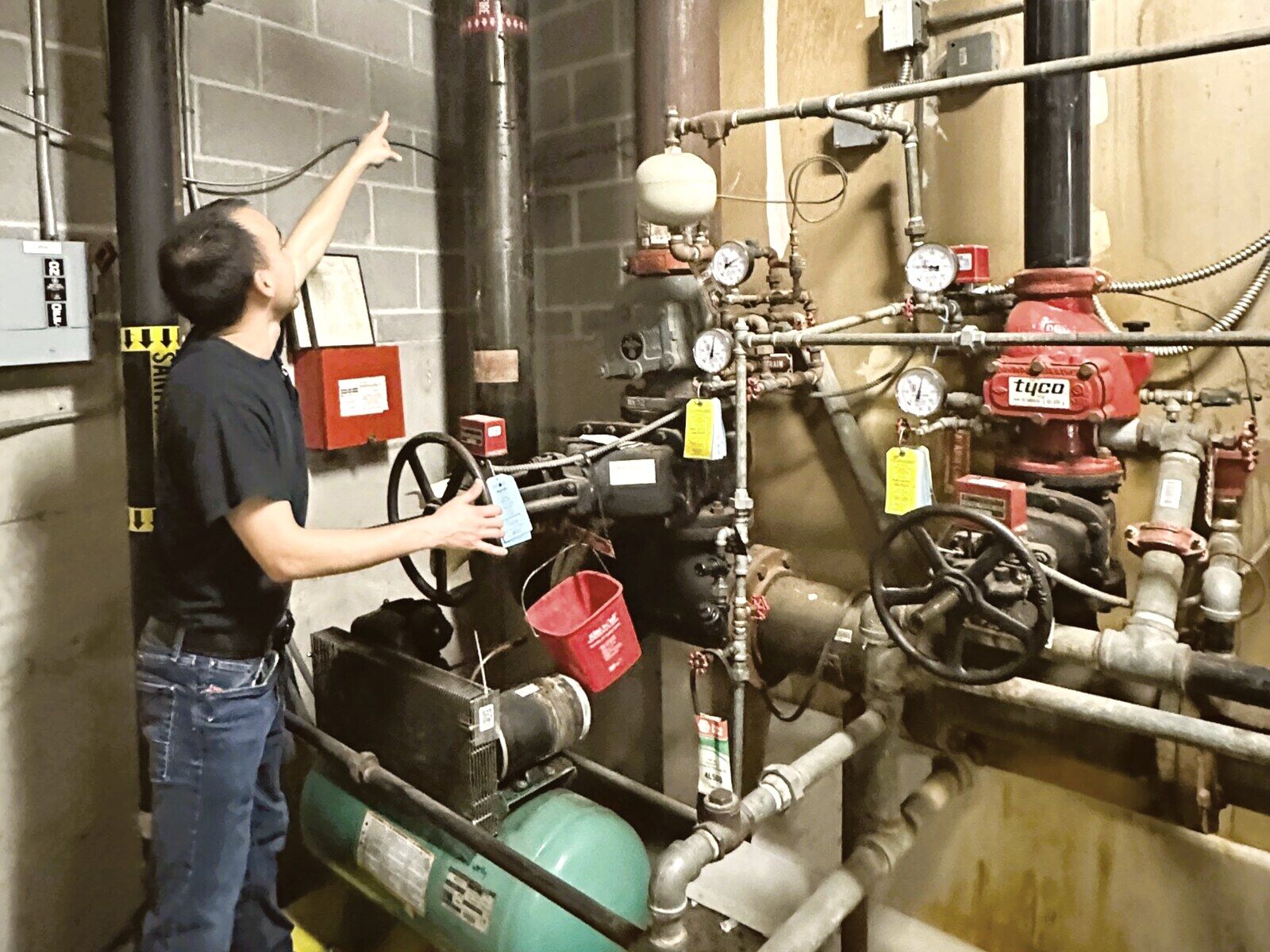
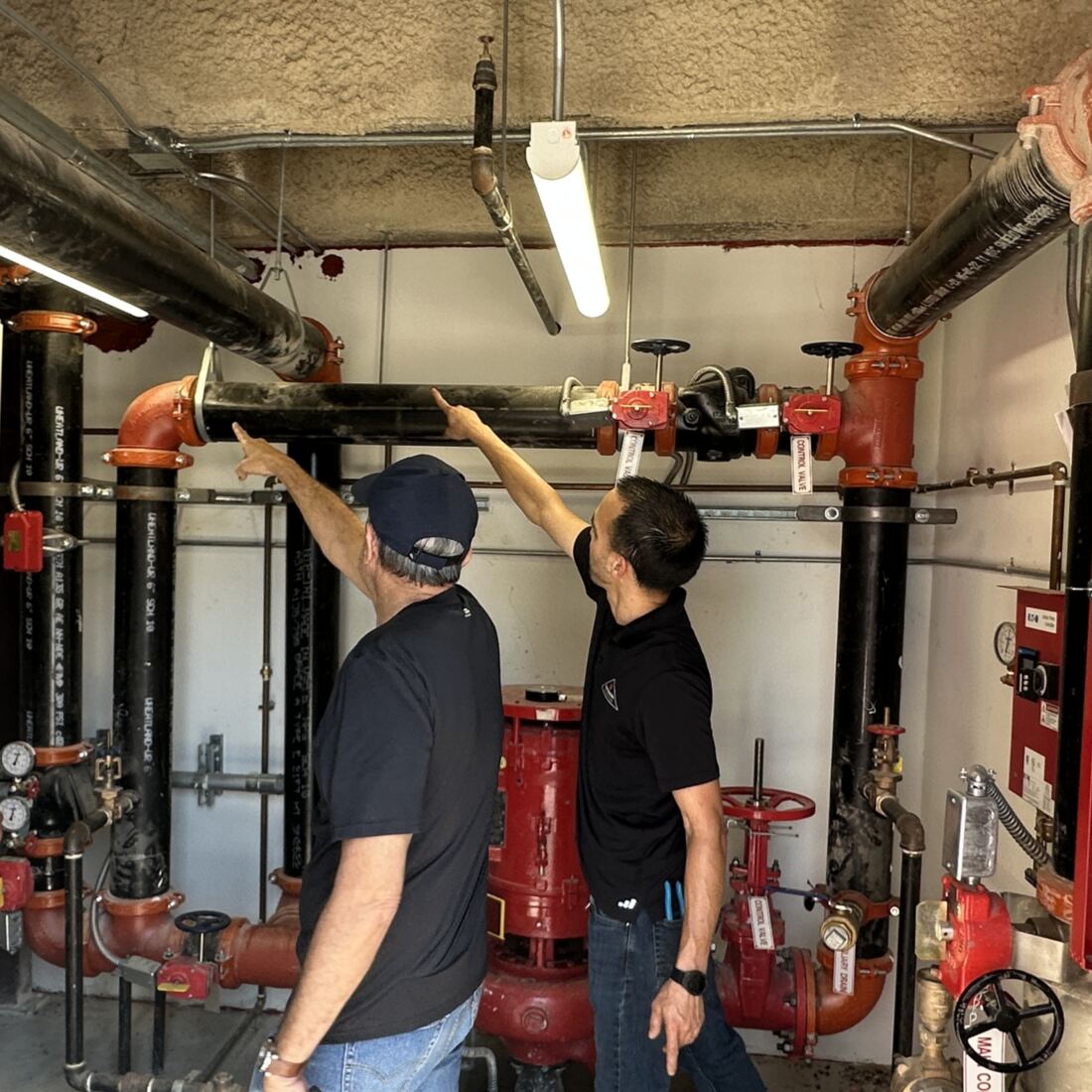
How often things get checked depends partly on the type of system. Most of the work happens at the riser, which is the main pipe and valve assembly where water enters the building. The riser room holds the control valve, the gauges, the main drain, and (on a dry system) the dry-pipe valve and the air compressor. Code wants that room kept above 40°F and clear enough to walk into.
| System | How it works | Where you’ll find it |
|---|---|---|
| Wet | Pipes are always full of water. Simplest and most common. | Heated spaces: offices, retail, most apartments |
| Dry | Pipes hold pressurized air. A dry-pipe valve holds the water back at the riser until a sprinkler opens and the air bleeds off. | Unheated spaces: parking garages, loading docks, unheated warehouses and storage |
| Preaction | Pipes hold air. Water only enters after a separate detector trips, then it behaves like a wet system. A “double-interlock” version waits for both a detector and an open sprinkler. | Places where an accidental soaking is expensive: data centers, telecom rooms, archives, freezers |
| Deluge | Every head is open. When the valve trips, all of them flow at once. | Specific high-hazard areas: aircraft hangars, fuel and chemical handling |
Most DFW commercial buildings are wet-pipe. Dry systems show up wherever the pipes would otherwise freeze. There’s a tradeoff with a dry system: it protects unheated space, but its low points collect condensation that can freeze and split. We’ve replaced a drum drip split by a hard freeze on a self-storage building, the kind of failure that takes the whole system offline until it’s fixed. That’s why the low-point drains are on the seasonal checklist below.
The inspection and testing schedule
NFPA 25 spreads the work across several intervals. Some of the quick visual checks can be done by trained on-site staff. The tests and the longer-cycle work have to be done by a licensed inspector (more on Texas licensing below). Here’s the cadence for a typical sprinkler system.
| How often | What happens | Who |
|---|---|---|
| Weekly / monthly | Eyeball the gauges (normal pressure) and confirm control valves are open and sealed. Dry and preaction systems lean weekly; wet systems, monthly. | On-site staff or technician |
| Quarterly | Test the waterflow alarm (the bell/gong), check valves that are wired to the alarm panel, and inspect the fire department connection. | Licensed inspector |
| Semiannual | Test the electric waterflow switches and the valve tamper (supervisory) switches. | Licensed inspector |
| Annual | Full walk-down of every sprinkler, the pipe, hangers, and signage. Main drain test. Antifreeze test on any antifreeze loops. Trip-test each dry-pipe valve. Confirm heat is on before winter. | Licensed inspector |
| Every 3 years | Full-flow trip test of each dry-pipe valve. | Licensed inspector |
| Every 5 years | Open the pipe and inspect the inside for corrosion, scale, and obstructions. Replace or recalibrate the gauges. | Licensed inspector |
| By age | Sample-test the sprinkler heads themselves: standard heads at 50 years (then every 10), quick-response at 25 years, dry-type at 20 years, and heads in harsh or high-heat spots at 5 years. | Licensed inspector |
A few of these are worth a plain-English note, because they’re where the schedule trips people up.
Why valve checks have different intervals. It comes down to how the valve is secured. A valve that’s only sealed gets looked at weekly. One that’s padlocked, monthly. One that’s wired to your alarm panel so it reports if someone touches it, quarterly. The more tamper-resistant the valve, the less often a person has to physically eyeball it.
The main drain test. A technician opens the main drain and watches the pressure. If the flow has dropped since last year, something upstream is choking the supply, often a backflow preventer going bad or a valve that’s been partly closed. It’s the cheapest early-warning test on the system.
The dry-pipe trip test. The only way to know a dry valve will actually trip is to trip it. NFPA 25 wants a partial trip test every year and a full-flow trip test every three. Skip it and you’re guessing.
The intervals here follow the 2023 edition of NFPA 25. DFW cities adopt the fire code on their own timelines, so a few may still enforce an earlier edition. A licensed inspector works to the edition your city has actually adopted, and what an inspector verifies on site follows the same checklist year to year.
The 5-year internal check
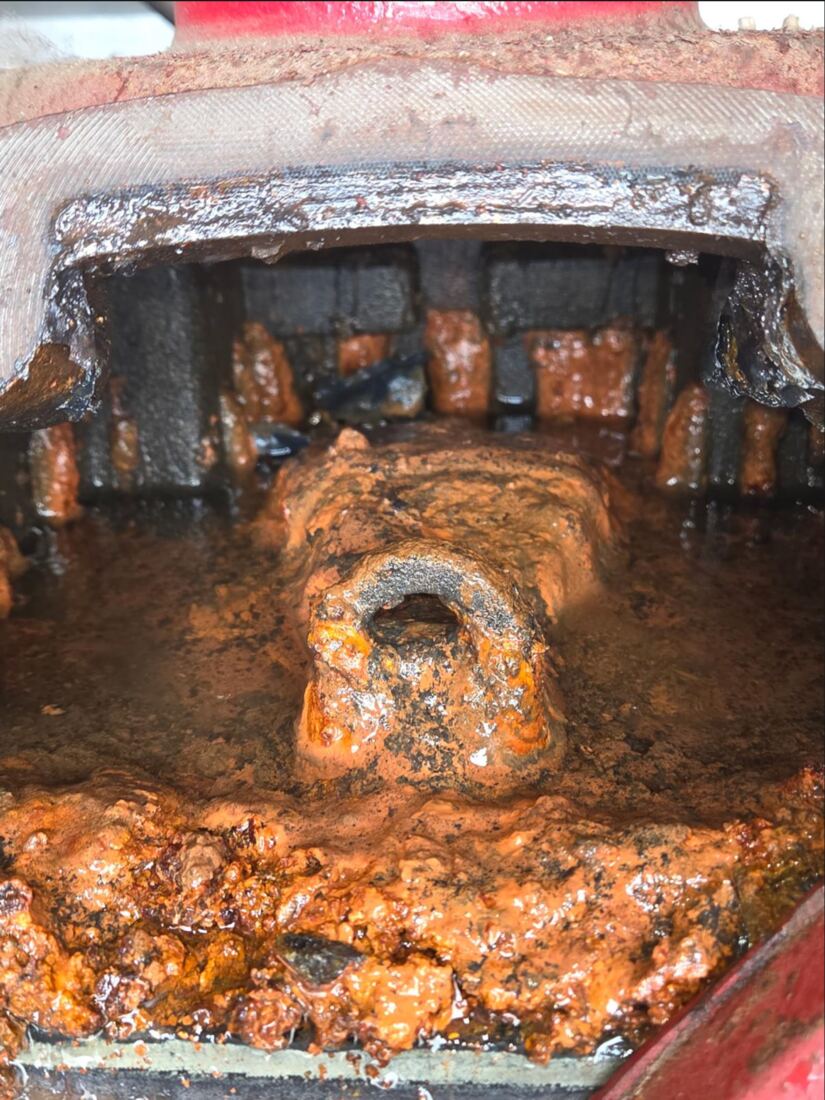
Once every five years, a technician opens the system and looks inside the pipe for rust, scale, and anything blocking the flow. If they find enough buildup, that triggers a deeper obstruction investigation. It’s the one check you can’t fake from the outside, and it’s the one most often skipped because a system can look fine while it’s quietly corroding.
Dry systems earn the most attention here. Air plus leftover water equals corrosion, and a dry valve packed with scale won’t trip when it counts. We walked into a dry system in Irving carrying a yellow (deficient) tag with a dry valve so gunked up it would not have operated in a fire, running off an unlisted compressor the city had flagged on sight. After the 5-year inspection, a clean valve, and a properly listed compressor, it went back to a blue (passing) tag. That whole job lives under preventative maintenance and the annual system inspections that catch this before an inspector does.
What DFW fire marshals flag most often on sprinkler inspections
Across commercial inspections in Dallas, Fort Worth, and Irving, the write-ups cluster around the same handful of items:
- A control valve found closed. The single most common reason a sprinkler system fails in a real fire is that somebody shut a valve and never reopened it. Inspectors check valve position first.
- Painted, corroded, or dust-loaded heads. Paint and heavy buildup change the temperature a head opens at. NFPA 25 calls for replacing heads where the condition hurts performance, not scrubbing them clean. We’ve pulled a head painted over by a building paint crew, a loaded and corroded ceiling head, and a corroded head inside a walk-in cooler where the moisture eats standard heads in a year or two.
- Blocked clearance. Storage stacked within 18 inches of the sprinkler deflector blocks the spray. The 18-inch rule is from the install standard, but inspectors write it up as an obstruction.
- Missing or wrong spare heads. You need a cabinet of spare sprinklers matching every type in the building (6, 12, or 24 depending on system size) and the correct wrench for each. It’s an easy citation to avoid.
- Fire department connection problems. Missing caps, a blocked connection, or no signage.
- Overdue paperwork. The fire code wants ITM records kept and available, usually for at least three years. If you can’t produce them on the spot, that’s its own write-up.
- Dry-system neglect. Low air pressure, a failing compressor, or low-point drains that never got drained before winter.
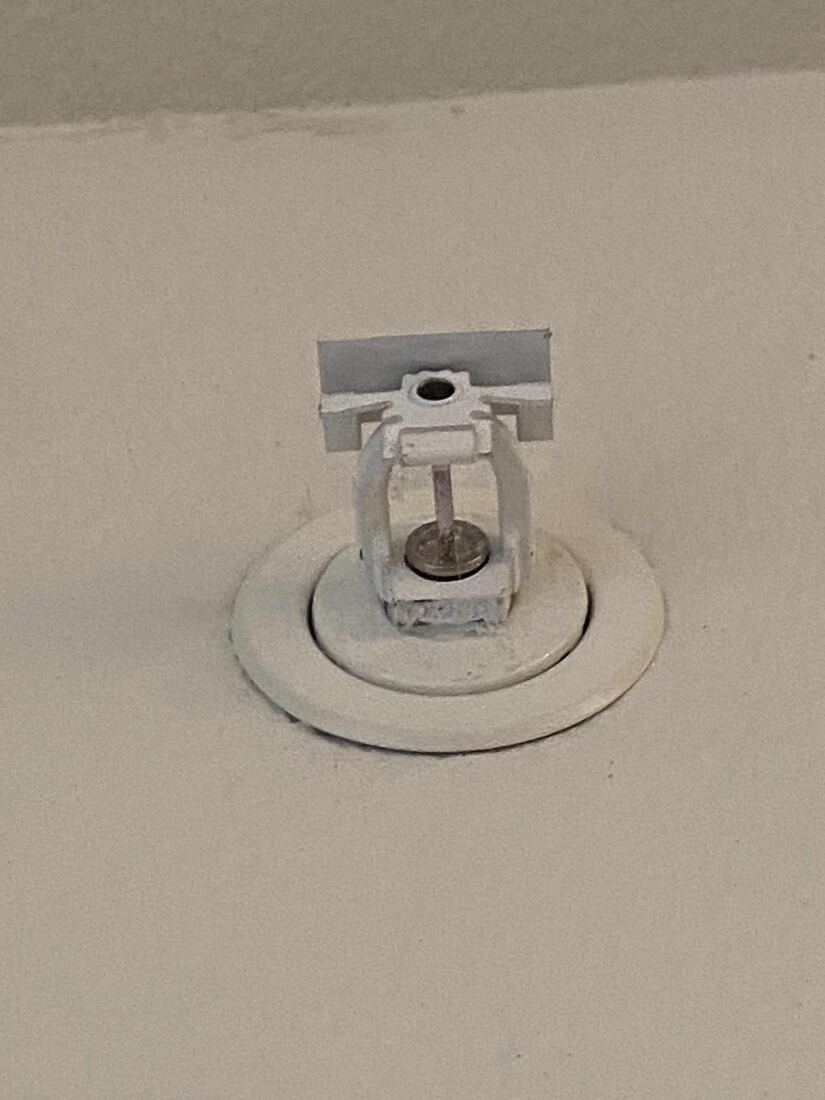
One that surprises people: a missing escutcheon (the trim ring around a recessed head) isn’t cosmetic. It’s part of the listed assembly, and the gap it leaves can let heat slip past and delay the head opening.
Catching the corroded riser flange or the weeping joint early matters for the same reason. We found a corroded, leaking flange in an Irving riser room and rebuilt it on a planned shutoff, instead of waiting for the 2 a.m. after-hours emergency it was turning into. Most of these citations are preventable with a schedule somebody actually owns.
Who’s allowed to do this work in Texas
Past the basic visual checks, a sprinkler inspection isn’t a do-it-yourself job. Texas licenses sprinkler work through the State Fire Marshal’s Office at the Texas Department of Insurance, under Texas Insurance Code Chapter 6003.
The short version:
- The company holds a Sprinkler Certificate of Registration (SCR). General commercial work falls under the SCR-General type.
- The individual doing the work holds either an RME-General license (design, install, and inspect) or an RME-General Inspector license, often shortened to RME-I, which covers inspection, testing, and maintenance only, not installation.
Paragon carries the firm registration, and our inspectors hold the appropriate RME license. The backflow preventer on your fire line is a separate matter: that’s an annual test by a tester licensed through the state environmental agency, and it falls under our backflow service rather than the sprinkler inspection itself.
Records and electronic reporting
Texas cities enforce sprinkler upkeep through the International Fire Code, which points to NFPA 25 for water-based systems and wants your ITM records kept and ready for the inspector who asks, usually for at least three years. Some DFW cities have gone a step further and now require those reports filed electronically through a third-party portal. Carrollton, for one, moved to electronic inspection reports for sprinkler, alarm, and other system reports, and Weatherford has required the same since 2022. We file to the Carrollton authority and every other jurisdiction we serve, the same day the inspection wraps.
None of this is exotic. A wet system in a heated building needs a few quick visual checks through the year, one annual inspection, and a look inside the pipe every five years. A dry system needs all of that plus attention to its air pressure and low-point drains before the first freeze. The buildings that get cited are almost always the ones where nobody owns the calendar. The ones that pass are the ones where somebody does.
Talk to an Expert
Call (469) 474-5190 anytime for emergencies.
More Posts
Read next
-
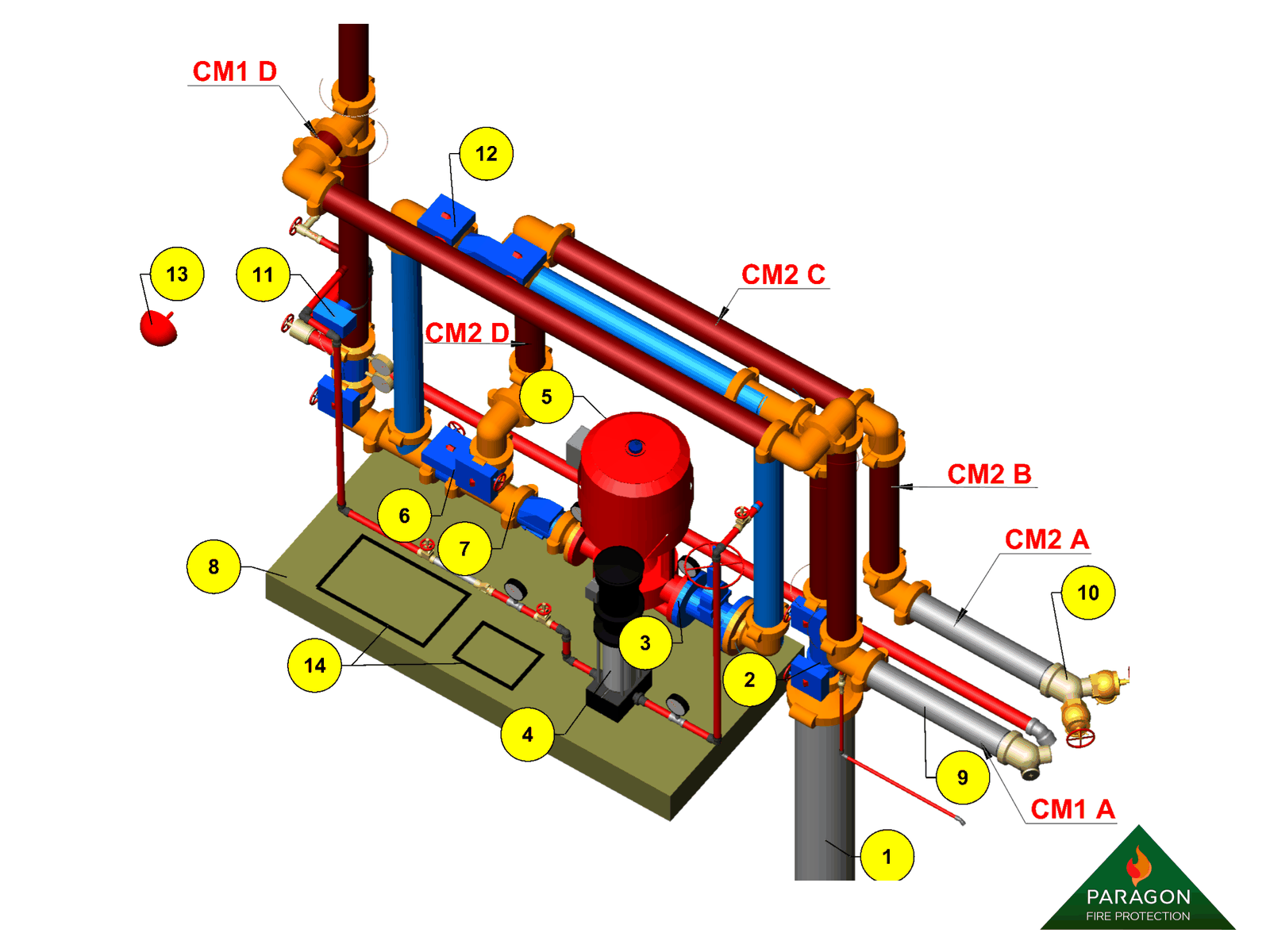
Commercial Fire Pumps: What NFPA 20 and NFPA 25 Require
When a commercial building needs a fire pump, how a skid-mounted install works under NFPA 20, and the NFPA 25 test schedule fire marshals enforce.
-
Commercial Fire Extinguisher Types and NFPA 10 Inspection Requirements
ABC dry chemical, Class K wet chemical, CO2, clean agent, water mist. What each fights and the NFPA 10 service intervals DFW fire marshals check.